Normal deep links assume the app is already installed. Deferred deep linking handles the harder, more valuable case: someone taps a link before they have your app, installs it from the store, and on first open still lands on the exact screen they came for. This post explains how deferred deep linking works — and how to do it without shipping a native SDK.
What is deferred deep linking?
"Deferred" means the deep link's destination is remembered across the install gap. The flow looks like this:
- A person taps your deep link but doesn't have the app.
- They're sent to the App Store or Google Play and install it.
- On first launch, the app asks "was there a link that brought this person here?" and routes them to that screen.
Without deferral, that new user opens the app to a generic home screen and the context of what they clicked is lost — a big drop-off point for referrals, ads and campaigns.
How deferred deep linking works
Because an app store install breaks the direct link between the tap and the first open, deferred deep linking has to match the two events. Approaches range from exact matching (a click identifier passed through the store, where supported) to probabilistic matching (comparing signals like IP address and platform within a short time window). Probabilistic matching is best-effort by nature — it's a close estimate, not a guarantee.
Do you need an SDK?
Traditionally, deferred deep linking meant integrating a native mobile SDK. But you can get a lightweight version without an SDK using a simple web + API approach:
- When someone taps the link, the server records the intended destination against a short-lived, coarse fingerprint (IP + platform).
- On first app open, your app calls a REST resolve endpoint once. If there's a recent match, it returns the destination payload and your app routes to it.
This is honest about its limits — IP+platform matching is probabilistic and best within a short window — but it needs no native SDK, just one API call on first launch. It's the most practical option for teams who want deferred routing without adopting a full mobile-measurement stack.
A deferred deep link example with lynkily
lynkily Deep Links implements exactly this SDK-less pattern. Every deep-link tap is recorded; your app calls the resolve endpoint on first open:
GET /api/deeplink/resolve/?app=YOUR_APP&platform=ios
→ {"matched": true, "deep_link": {"path": "/product/123", "url": "https://…"}}
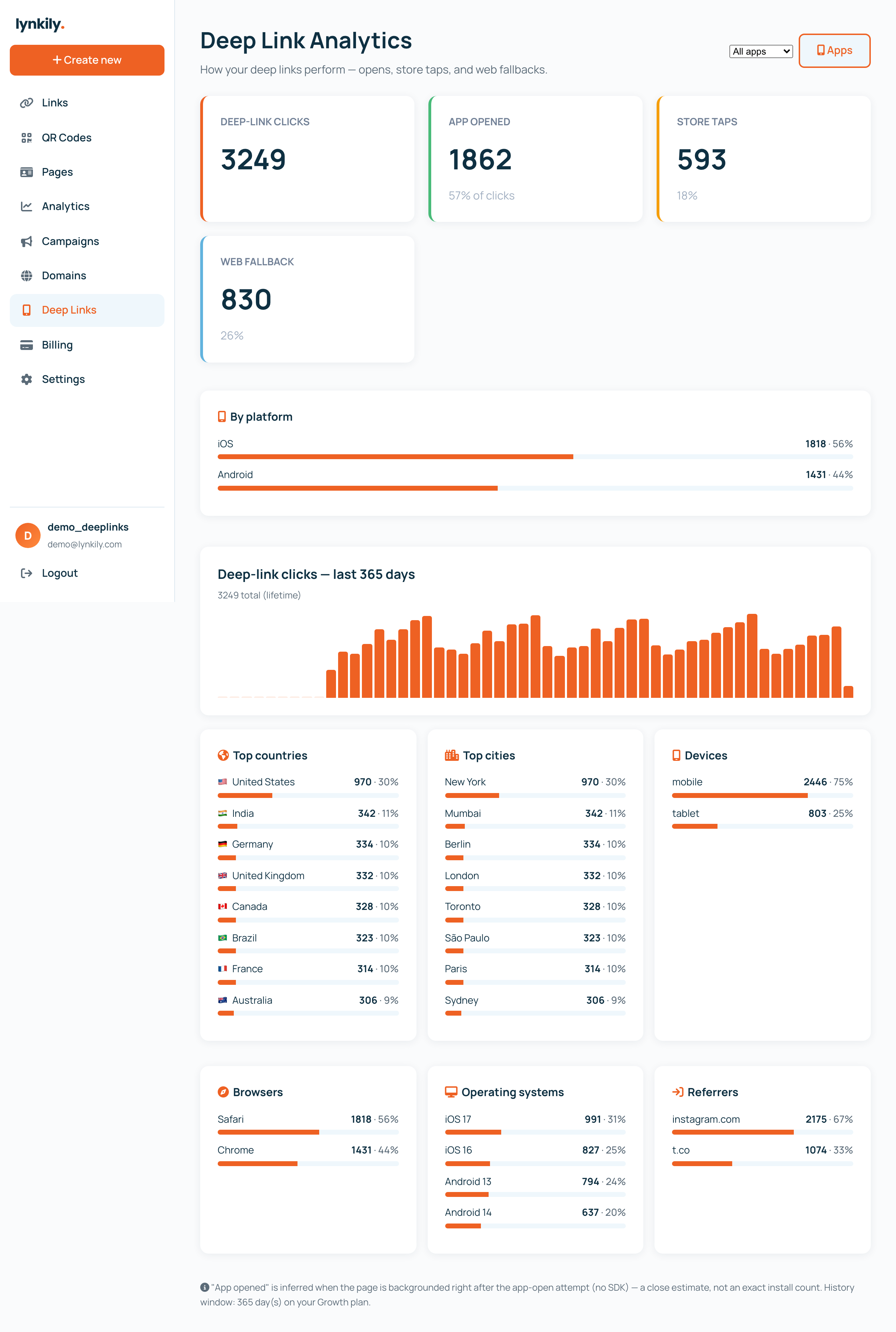
You can also subscribe to a webhook that fires when a deferred link resolves, and see it all in deep-link analytics alongside app opens, store taps and web fallbacks.
When deferred deep linking matters most
- Referrals: land invited users on the referred content after install.
- Paid campaigns: keep the promised destination intact through the store.
- Content sharing: a shared product or profile still opens correctly for brand-new users.
New to deep links generally? Start with what is deep linking, or compare the link types in Universal Links vs App Links.